Customer Research
Sales and customer service teams across different Sage legacy products highlight the necessity for integrated payment solutions to compete effectively with other accounting software providers. I established connections with users across these products and conducted generative interviews. This process revealed numerous insights and commonalities among multiple user bases:
Primarily small business owners.
Highly familiar with their current Sage product and are reluctant to invest time and effort in learning a new platform.
Prefer one-time purchases over monthly subscriptions.
Cautious about digital solutions, harboring concerns about the security of their financial documents in the cloud.
Have not migrated to competitors due to the need to retain their historical accounting data, which poses challenges in transitioning to another platform.
“I have no idea when they get [the invoice]…it might be the next day or it might be down in the mail room. I only know they got the bill if I get a check in the mail or if they call to ask about a charge.

Basic Flow
Collaborating with multiple desktop software and payment services development teams, we agreed upon a basic user flow that integrates all essential security and third-party touchpoints.
An in-product CTA will activate the embedded web browser.
A security CAPTCHA will launch upon activation of the embedded web browser.
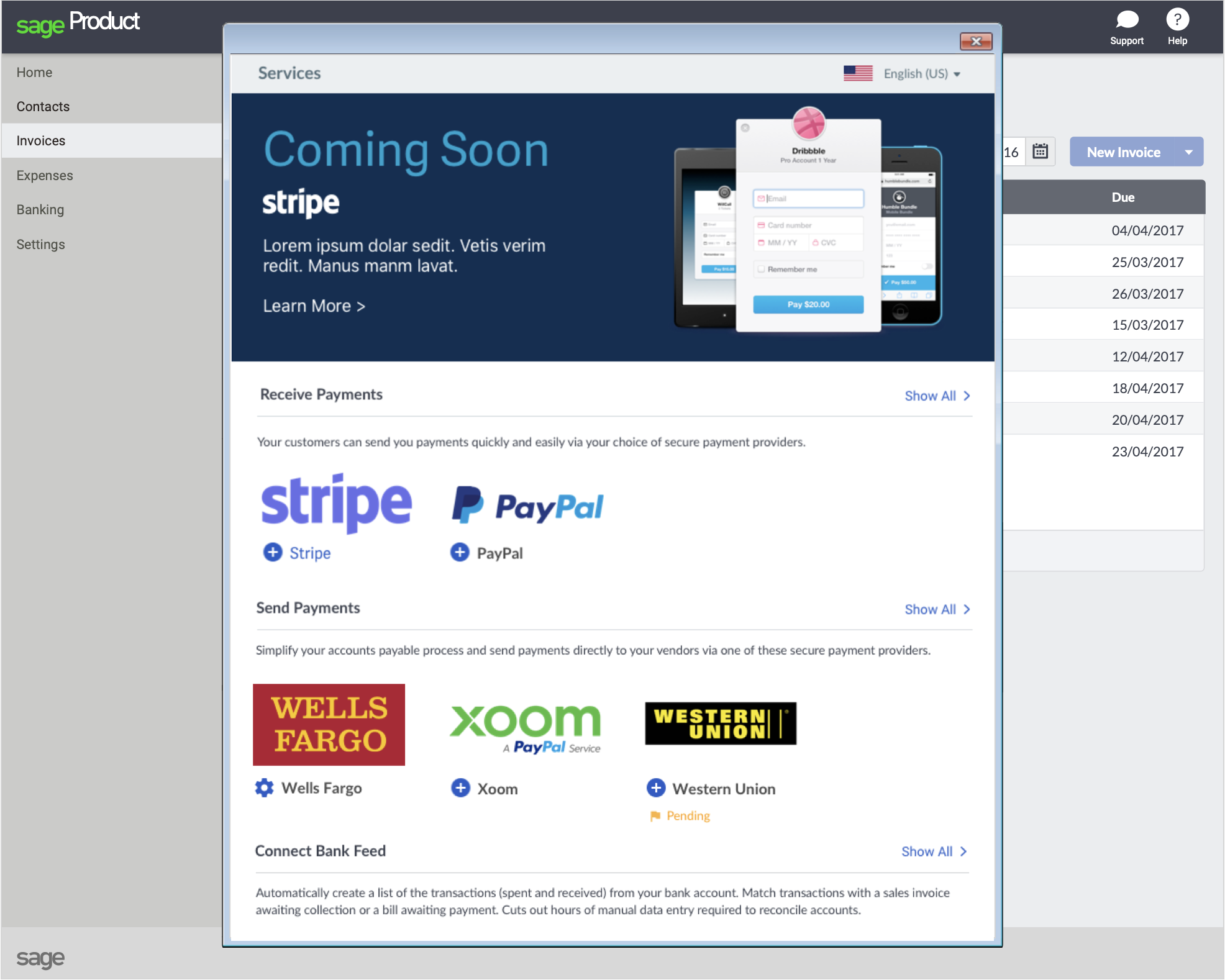
A 'Services' screen will present available third-party services relevant to the platform and market.
Each third-party service will feature a corresponding detail screen, initiating an account creation and connection flow (managed by the third party).
Upon successful connection to a third-party payment provider, the 'Services' screen will showcase connected providers and offer the option to update connection settings.
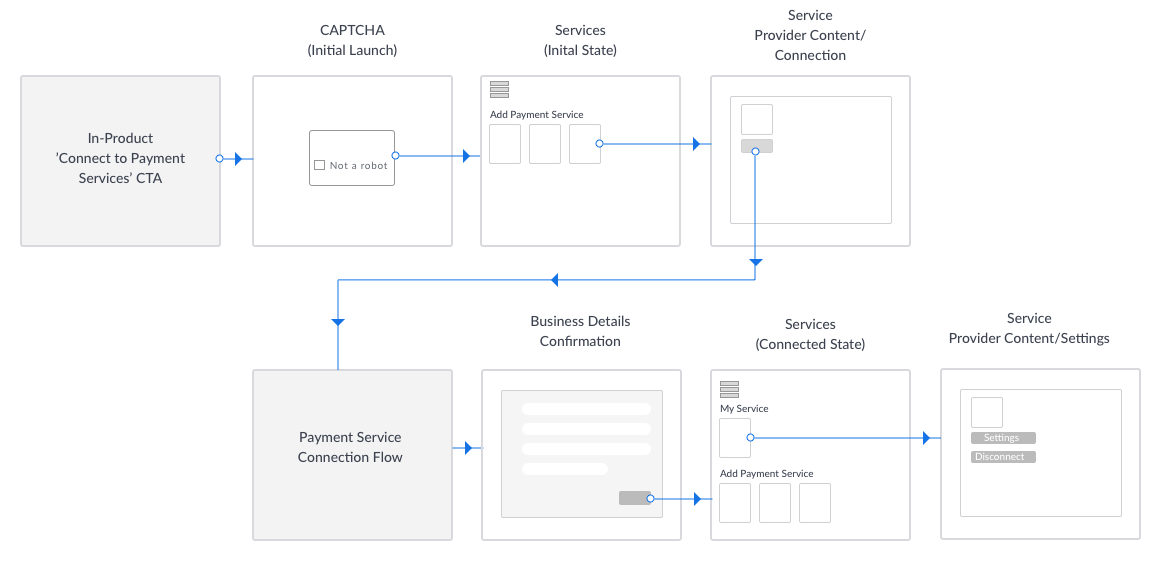
High level sketching for Payment In Cloud Service Connection.
The Cloud Payment Ecosystem
To establish connections with third-party digital payment providers within legacy Sage Business Unit Software like Sage 50 Accounting and Sage 100, it was essential to grasp the inherent technological limitations of these products.
Legacy Sage desktop accounting software features limited online connectivity, relying on outdated embedded browsers to access restricted online content.
Updates to these platforms are sporadic, sometimes distributed via physical media, requiring minimal changes to the existing desktop software UI.
Various Sage platforms will employ different third-party processors based on market and business agreements.

Initial user flow diagram for Payment In Cloud End to End Integration.
Mapping Out the Touchpoints
To aid stakeholders across all development teams in comprehending the third-party payment provider connection process, a service map depicting end-to-end integration is crafted and disseminated. Utilizing this flow, teams gauge the level of effort and synchronize schedules to formulate a development roadmap.
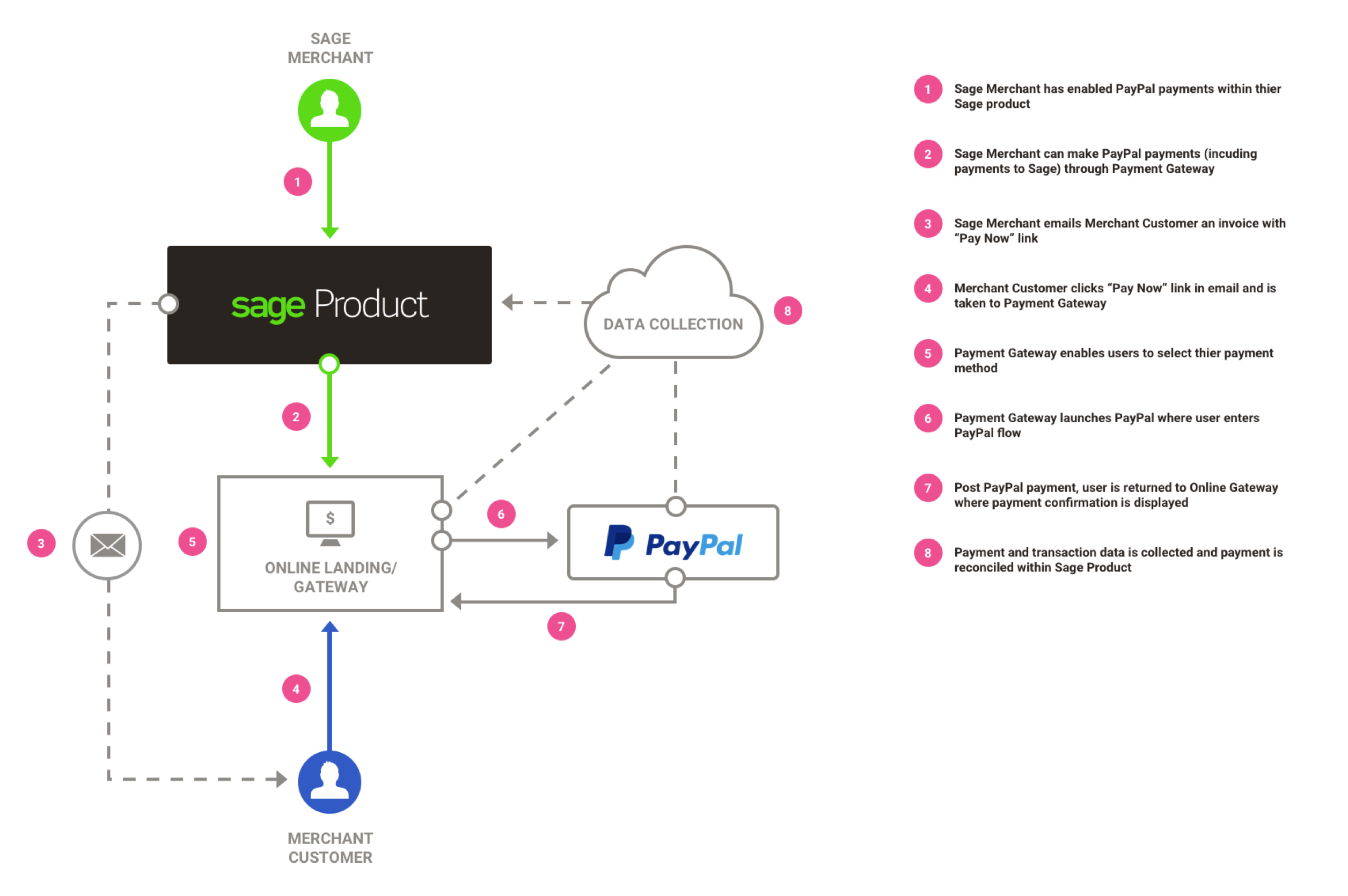
Service Map for Paypal integration.
Production Design
In collaboration with the development team, multiple lightweight, minimal designs are proposed, tested, and refined to enhance performance within the embedded web browsers of Sage desktop software.